
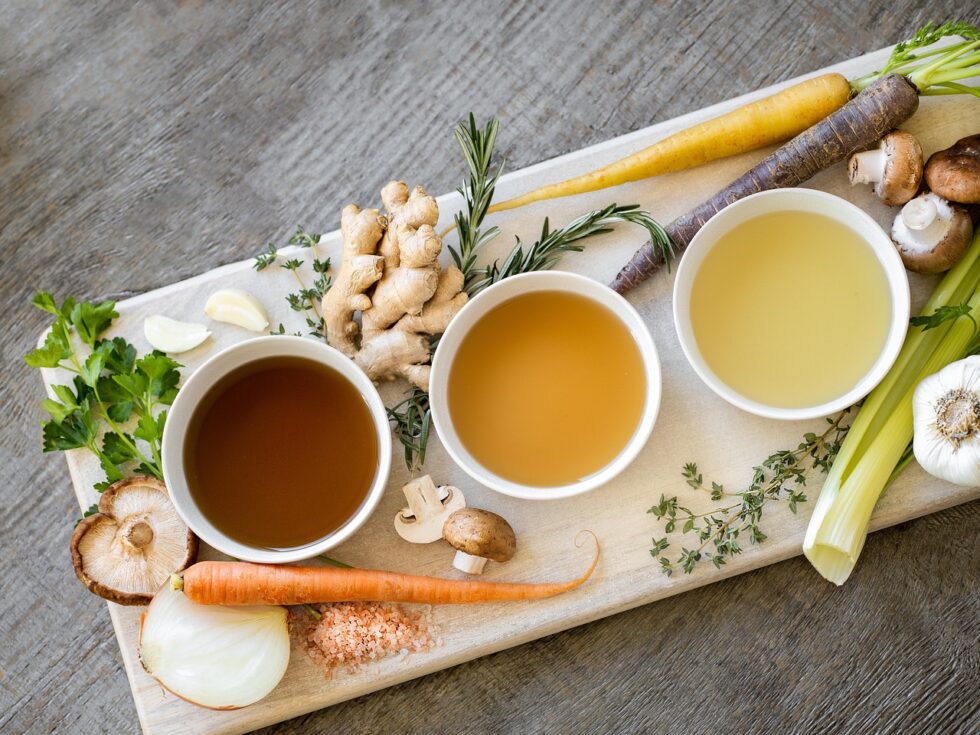
Boost Your Broth
When the weather turns cold, few things warm you as completely as a good bowl of soup. While soup is comforting on its own, its nourishing power increases dramatically when it’s made with a homemade broth. Most cooks are familiar with basic meat or vegetable broths, and these almost always outshine store-bought versions—which often rely on MSG derivatives and offer little real nutrition, even when labeled organic. Homemade broth, though, is something else entirely: rich, restorative, and almost magical. Add herbs, mushrooms, or seaweed, and you can elevate it even further into a deeply nourishing, flavor-packed base.
The Benefits of Broth
A basic broth is traditionally made by simmering leftover bones and/or vegetables in water for several hours with a splash of apple cider vinegar to help draw minerals from the ingredients.
Research suggests that nutrients released from bones—particularly collagen and gelatin—may support joint health, reduce chronic pain, improve skin conditions, strengthen bones, aid gut repair, support immune function, and help the body recover from common illnesses such as colds. These beneficial compounds are especially concentrated in knuckle bones and chicken feet, though all animal bones contribute valuable nutrients. For the best nutritional quality, choose bones from humanely raised or wild animals, ideally organic, pasture-raised, and/or grass-fed. These are often available at local farmers’ markets. Some vendors sell bones directly, or you can save bones from meals and store them in the freezer until you have enough to make broth.
Even without bones, a vegetable-based broth is rich in minerals and nutrients that support overall health. Broth is wonderfully versatile: enjoy it on its own, use it as a base for soups, cook grains and sauces in it, or freeze concentrated portions in ice cube trays for convenient future use.
Boosting Your Broth
Many herbs are especially well suited to broth. Some extract best through decoction—a slow, steady simmer—making broth an ideal medium. When bones are used, the natural fat further improves extraction by drawing out fat-soluble vitamins and compounds. Herbs that benefit from longer simmering include mushrooms, seaweed, mineral-rich herbs, fat-soluble herbs, and certain tonic herbs. Aromatic herbs, by contrast, should be added near the end of cooking to preserve their volatile oils and delicate flavors.
If you’re new to herbal broths, start with just a few tablespoons of herbs and gradually increase the amount. For a more therapeutic preparation, use one to two ounces of dried herbs per four liters of broth, simmered for three to twenty-four hours. Now, let’s explore a few simple ingredients that can further enhance the benefits of your broth!
Mushrooms
All medicinal and culinary mushrooms contain polysaccharides, including beta-glucans, which are known to support and modulate immune function. These compounds are best extracted through long, slow simmering in water, making broth an excellent preparation method. Regular consumption of mushroom-infused broths may help educate the immune system, supporting those who are prone to frequent illness as well as individuals with overactive immune responses, such as allergies.
Mushrooms have also been widely studied for their anticancer-supportive properties, particularly as complementary agents alongside conventional cancer care. Research has focused most heavily on turkey tail (Trametes versicolor), though shiitake, maitake, chaga, and reishi have also shown beneficial immune and anti-inflammatory effects. Reishi, cordyceps, and chaga are especially valued for supporting respiratory health, while many medicinal mushrooms are considered adaptogens, helping the body respond more effectively to stress and inflammation.
Start with one to two ounces of fresh, dried, or powdered mushrooms per four liters. For broth, tougher or woody mushrooms—and those that are past their prime for sautéing—are particularly well suited. I often reserve foraged mushrooms in this condition specifically for broths, where their medicinal compounds can be fully extracted.

Seaweed
In many Asian culinary traditions, it is common to add a strip or two of seaweed to a gently simmering pot of broth. Seaweeds are naturally rich in a wide range of minerals, including iodine, calcium, magnesium, and selenium, and they also enhance broth with a deep, savory umami flavor.
Brown seaweeds such as kelp and wakame tend to be especially high in iodine, which may be beneficial for individuals with iodine deficient hypothyroid conditions. Red seaweeds like dulse and nori generally contain lower levels of iodine, but are relatively richer in selenium, an important mineral for thyroid and immune function.
Beyond their mineral content, seaweeds may help improve digestibility. When added to soups that include legumes, seaweed has traditionally been used to help reduce gas and bloating. Only a small amount is needed to achieve these benefits. Be sure to source seaweed from suppliers that harvest in clean, tested waters to avoid contaminants.
Nettle (Urtica dioica)
Nettle is a mineral-rich powerhouse, providing significant amounts of calcium, magnesium, potassium, and iron. When prepared as a decoction rather than a simple infusion, nettle releases substantially more minerals—particularly calcium. Nettle also exhibits mild antihistamine activity, which may help ease allergy symptoms for some individuals. However, it is also a diuretic, meaning it can increase urination. This action supports kidney function and promotes the elimination of uric acid, but it also means nettle should be introduced gradually. Begin with small amounts of nettle—either fresh or dried—and slowly increase the quantity as your body adjusts.
Burdock root (Arctium lappa)
With its slightly bitter and woody flavor, burdock root is a gentle yet profoundly cleansing plant. It traditionally supports liver, lymphatic, and kidney function and is commonly used for skin health, particularly in conditions such as eczema. Burdock root is also rich in inulin, a prebiotic fiber that nourishes beneficial gut bacteria and supports digestive health.
Burdock contains a wide range of nutrients and phytochemicals. Harvesting wild burdock provides the most medicinally potent root, though digging it can be physically demanding. Cultivated fresh burdock root—often labeled gobo—is widely available in Asian markets and is excellent for culinary use, though it is generally less potent medicinally. For convenience, dried burdock root from a reputable herb shop can be easily added to broths and offers reliable therapeutic benefits. You’ll want to add about one to two tablespoons per four litres of liquid.
Ashwagandha (Withania somnifera)
This well-known Ayurvedic herb has a strong, earthy aroma reminiscent of raw potatoes. As an adaptogen, ashwagandha helps the body adapt to stress, promoting balanced energy during the day and supporting restful sleep at night. Research and traditional use suggest it may help reduce anxiety, enhance cognitive function, ease chronic pain and inflammation, and boost libido.
Ashwagandha is generally well tolerated, but individuals who are sensitive to plants in the nightshade family may also react to it. In some cases, it can induce drowsiness, so it is best introduced gradually (start with 1 oz per four liters), particularly if taken during the day
Calendula (Calendula officinalis)
These bright yellow-orange flowers are rich in carotenoids, including beta-carotene, lutein, and zeaxanthin, which give broth a vibrant golden hue. Beyond their nutritional value, calendula is valued for its anti-inflammatory effects, lymphatic support, and gut-healing properties, and it may also help strengthen the immune system.
Calendula can become bitter in large amounts, so start with a small quantity and adjust to taste. Individuals who are sensitive to plants in the daisy family (Asteraceae) may need to use this herb with caution.

Turmeric (Curcuma longa)
Turmeric is rich in carotenoids, most notably curcumin, a powerful antioxidant known for its anti-inflammatory properties. Curcumin is best extracted when heated and combined with fat and black pepper, making it an excellent addition to bone broth. Traditionally, turmeric has been used to support chronic pain management, as well as liver detoxification and bile production.
Turmeric is generally well tolerated, but high doses may interact with certain medications. It also contains modest levels of oxalates, which can pose issues for some individuals prone to kidney stones or oxalate sensitivity.
Other herbs to consider
Paprika: for colour and taste; antioxidant
Cayenne: for taste, improves circulation, warms
Lemongrass: for flavour, anti-oxidant and anti-inflammatory. Add in the last 30 min of simmering).
Bay leaves: flavour and also a nerve tonic
Astragalus: premier immune herb
Marshmallow root or leaf: soothing and slimy to aid gut repair
Horsetail: rich in silica and calcium, good for skin and bone health. Use only small amounts and don’t consume regularly.
Combinations to get you started
Skin broth: Chicken feet or beef knuckles, burdock, calendula, nettle, oat straw, a pinch of horsetail, and turmeric
Immune broth: Chicken bones, any type of mushroom (including culinary), astragalus, calendula, garlic, onion, bay leaf. Add some miso paste after it has finished simmering
Nutrient-dense broth: Beef and/or veggie broth, nettle, oat straw, mushrooms, calendula
Gut repair broth: Beef knuckles or chicken feet, marshmallow root and/or leaf, mushrooms, calendula, oat straw
Antioxidant-rich broth: Chicken and/or veggie broth, shitake mushrooms, turmeric, paprika, bay leaf, calendula.
References
Bone Broth Nutrient Composition & Gut Health
Zaporojan, V. et al. Bone Broth Benefits: How Its Nutrients Fortify Gut Barrier in Health and Disease. Review article summarizing amino acids (e.g., glutamine, glycine, proline) and minerals in bone broth and their effects on gut barrier integrity and inflammation. PubMedCollagen Supplementation & Bone Health
König, D. et al. Efficacy of collagen peptide supplementation on bone and muscle health: a meta-analysis. Meta-analysis of several randomized controlled trials showing collagen peptides can improve bone mineral density and may have roles in musculoskeletal health. PubMed CentralCollagen & Joint Health
The top 6 bone broth benefits: Research overview noting that type II collagen from chicken connective tissue improved symptoms in people with osteoarthritis (Nutrition Journal study). Medical News TodayGlutamine & Gut Function
Reviews of amino acids like glutamine (a significant component of bone broth) indicate they play roles in gut mucosal maintenance and reducing inflammation, supporting gut health in both animal and mechanistic studies. PubMedCollagen Peptide vs. Broth Content
Alcock, R. D., Shaw, G. C., & Burke, L. M. Bone Broth Unlikely to Provide Reliable Concentrations of Collagen Precursors Compared With Supplemental Sources of Collagen Used in Collagen Research. Study highlighting differences between bone broth and concentrated collagen supplements used in clinical trials. Intelligent Labs CA